
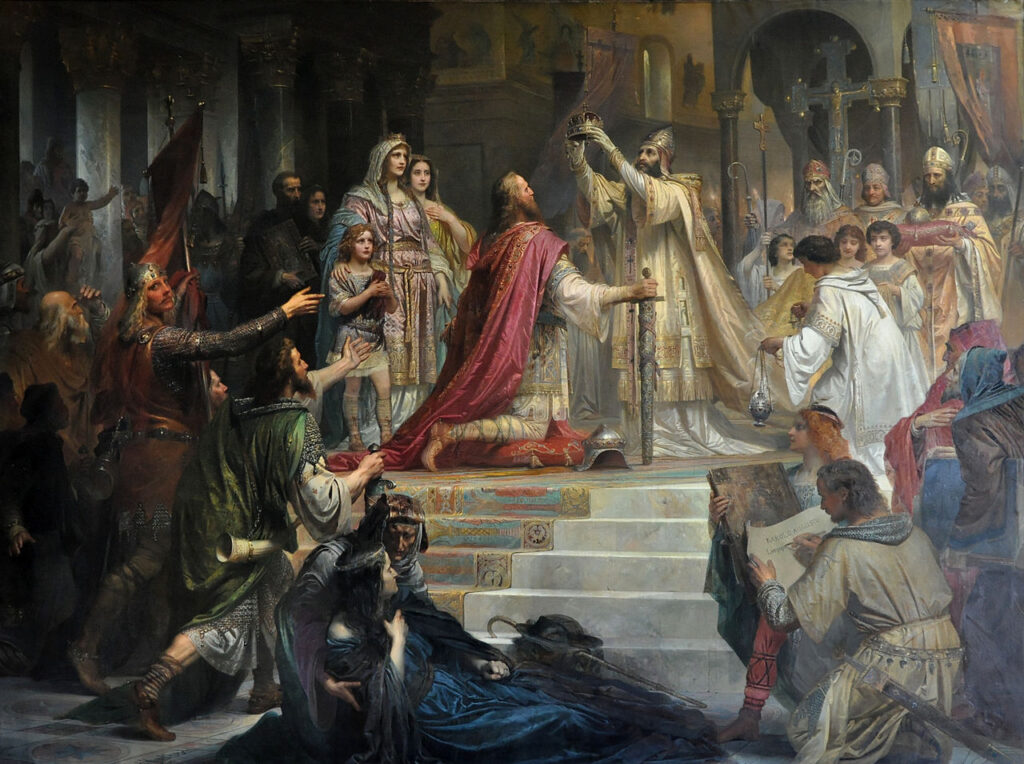
On Christmas day in the year 800 AD, Pope Leo III crowned Charles Magnus, King of the Franks, as Emperor of the Romans. On that auspicious day, a new era in the history of Europe was ushered in. Charles became the first recognized emperor in western Europe since the abdication of Romulus Augustus in 476 A.D. The Pope placed a gold crown on Charles’ head while the crowd in attendance proclaimed him Emperor with prayers and benedictions for life and victory. The ambassador from the patriarch of Jerusalem was on hand to present the keys to the holy sepulchre. Although the site was in Arab possession since 636, this act symbolized Charles’ assumption of the ancient Roman mission of protecting Christianity. His official title was Charles Augustus, crowned by God, great and peaceful emperor, ruler of the Roman Empire and, by the grace of God, King of the Franks and Lombards. From that day on, hew would be known as Charlemagne.
It was a political earthquake. After more than three hundred years, there was once again an emperor in the West. The old order was gone. No longer would Byzantium be the sole claimant to leadership of what remained of the Roman Empire.[4] The revived empire in the West had claims that were just as solid as those of Constantinople. It had territorial integrity, military might, strong leadership and, of great importance to the Latin Christian world, the approval of the Pope of Rome. Indeed, Pope Leo regarded Charlemagne as the only legitimate emperor since the Byzantine throne was occupied by a woman and therefore invalid according to Salic tradition. The fact that this woman had usurped the throne by murdering her son rendered her doubly loathsome in the eyes of the Pope. [1]
[1]John Julius Norwich. A Short History of Byzantium. Penguin Books. London . 1997 pg 119
The seismic waves rippled outward from Rome to the known world with powerful aftershocks. The Byzantines were appalled at what they regarded as sacrilege and a breathtaking usurpation of their authority. Venice erupted into tumult realigning its alliance system to the rising power of the Franks.[2] The Saxon Kings of Wessex, Mercia and Northumbria, as well as Spain paid him homage; the Caliph of Baghdad sent an embassy and recognized him as the protector of the Christian shrines in Jerusalem.
The coronation of Charlemagne was the central event of the Middle Ages.[1]It arrested the descent into chaos of the West and established a new paradigm of power and rule which was to prevail until the accession of Charles V in 1519. Pope Leo’s crowning of Charlemagne was an intentional declaration of the unification of the temporal might of the Franks with the spiritual authority of Rome. Although such a union had been affected previously by Charlemagne’s father Pippin III and Pope Stephen II, it had not been done with such ostentation and pageantry, and certainly not on such a propitious day. Christmas Day 800 was not only a central Christian holy day but was believed to be exactly 7000 years since the creation. The coronation was conspicuously done in Rome, the seat of the Caesars and the city associated with Peter and Paul, the most famous of Christian Apostles.[2] Moreover, Pippin was anointed only as King, not as a Roman Emperor. Charlemagne’s coronation was nothing less than a desire to revive the glory of Rome and its legitimacy, its power, integrity and its unity. It was, in essence, a longing after the mirage of Rome.
The mirage of Rome had compelled and driven men since the end of the fifth century AD. Like a mirage it appeared shimmering on the horizon, seemingly attainable but always just beyond reach. Like a mirage it appealed to the thirsty and the weary, to people who yearned for rest and peace. It tantalized those who eschewed anarchy and were willing to submit to a powerful but benign ruler who could secure the borders, keep the peace, ensure prosperity and allow men to live in contentment by hearth and home.[3]
Indeed it was a mirage of empire for it lacked all the forms and substance of a viable empire. It had no fixed capital city, no palace, no network of roads and communication, no common currency or common institutions that one traditionally associates with empire. This lack of form and substance was to be a defining characteristic of the Holy Roman Empire until its demise in 1806 and, no doubt, a main reason for Voltaire’s cheeky dictum that The Holy Roman empire was neither holy, roman nor an empire. (The fact that the emperor was not in Rome was a huge reason for the empire’s lack of stability.)
The Rome they wistfully recalled was an empire where the Pax Romana prevailed, and the writ of the emperor ran from Hadrian’s wall to Mesopotamia. It was a cohesive, contiguous polity connected by the Lingua Franca of the Latin language, efficient roads and waterways, serviced by functioning aqueducts, and guarded by well drilled, professional legions; where one could, whether Gaul or Jew, become a Roman citizen or watch spectacles in the coliseum or live in a villa whether in Hispania or Tunisia. It was also a Rome where, regardless of where you lived, the emperor was revered as a living god.[1]
Boris Johnson asserts that it was the concept of the emperor as a god – the cult of emperor -that gave to Rome its remarkable empire building powers. “It was a simple quid pro quo: you supported and upheld the imperial cult, and you received citizenship in return. There was slavery, of course, but you had the possibility of gaining your freedom and moving up the social hierarchy.”[1] It was this cult of emperor, ultimately, that enabled Rome to transition from its republican origins to a unified empire that completely encircled the Mediterranean sea. As[A1] the Roman Empire developed, the Imperial cult gradually developed more formally and constituted the worship of the Roman emperor as a god. This practice began at the start of the Empire under Augustus, and became a prominent element of Roman religion.
Augustus and many of his successors realized that the Roman Empire needed a common religion to bind together its many and heterogeneous elements. The worship of the genius of Rome and the Emperor was developed in its early days and did actually constitute for a long time a religious bond, typifying the unity of the roman world and nourishing loyalty to it. But at best it was an artificial thing superimposed upon existing faiths; and it promoted official and formal unity rather than any real inner and vital unity. [2][A2]
Emperor-worship was a unifying factor in the Roman world, practiced not only by army units spread throughout the empire but also by individuals in the provinces, where there were collective imperial cult centres at places such as Lyons (Gaul), Pergamon (Asia) and (probably) Colchester (Britain).
The imperial cult helped to focus the loyalty of provincials on the emperor at the centre of the empire, and in some regions (such as Gaul), there is evidence that Roman authorities took the initiative in setting it up, presumably for that very reason.[3][A3]
The emperor cult is also from the outset a way of integrating the provinces in the Roman realm and can therefore be seen as part of the process of romanization (Ørsted 1985: 15). In this context it can be mentioned that the Roman calendar of Julius Caesar was adopted by the province of Asia Minor and a new era begun on the birthday of Augustus as part of a plan to ‘honor the god’. This integrating aspect of the emperor-cult is often stressed when the change to Christianity is discussed, but it can be shown to have been important from the very beginning of the empire. [4][A4]
(Lily Ross Taylor – The Divinity of the Roman Emperor )[5][A5]
Says Johnson “The great advantage of the Roman system was that their emperor-god actually existed. Unlike Mercury, Jupiter or Hercules, you could actually see this god. If you were in Rome, you might watch him pass by or touch the hem of his garment. This had enormous political advantages, and it helps to explain how the Romans ran Europe and created that sense of unity that has eluded everyone else ever since. In the imperial cult, Augustus made a single channel, a confluence for people’s religious and patriotic feeling. Of course he was not the only god, nor by any means the most important god. But his cult was a way of expressing loyalty to him and to Rome.”[6]
The Genius Augusti speedily became for Roman citizens the object of a great state cult. It provided for the Roman emperor under veiled form a worship which was no less a ruler cult than was the more declared worship of the Hellenistic king as a revealed god on earth. As was true of the oriental ruler cult, the new worship became a symbol of the state and the observance of it became an expression of loyalty to the state. Just as in the east it was customary to take official oaths by the ruler himself or by his Tyche (goddess of fortune & luck), so among the Romans the official oath by the Genus of the emperor was established.[7] [A6]
The cult of Augustus was doubtless encouraged from above. It provided an effective means of securing the loyalty of the citizen body, and it offered in its priesthoods distinctions for the chief men of the cities which bound them to the emperor.[8][A7]
The notion of a divine ruler was not unique to Rome. It had been practiced since the beginning of recorded history, from ancient Sumeria where Naram-Sin of Akkad declared himself a divine ruler, to Imperial China, where the emperor was considered the Son of Heaven.[9] In Southeast Asia, the concept of divine king was expressed in the Hindu-Buddhist cult of Devaraja and, most famously, it had been the source of legitimacy for the Egyptian pharaohs who were believed to be incarnations of the god Horus.[10] It was a system that made the emperor an object of worship in addition to head of state, investing in one man the ultimate concentration of power, status and authority.[11] This combination of theocracy and absolute monarchy created an irresistible, monolithic power.[12]
Within a few decades of Augustus’ death in 14 AD, the Imperial Cult spread over the whole Empire, predominantly in the east where it grafted easily on to the established tradition of deified rulers. The Pharoahs and the Ptolomies of Egypt, Lycurgus and Lysander of Sparta, and Alexander the Great were all worshipped as divinities in life and in death, and it followed that the Roman emperor could also be worthy of the same kind of apotheosis.[13] Emperor worship continued right up to the reign of Diocletian in 284 AD who demanded that his subjects bow and prostrate themselves in his presence in an act known as the proskynesis and adopted the adjective ‘sacrum’ for all things pertaining to the imperial person.[14]
After Diocletian, the cult of emperor gradually began to die out in the west especially after Constantine granted toleration to Christians by the Edict of Milan in 313 AD and when Theodosius made Christianity the official religion of Rome by the edict of Thessalonica in 380 AD.[15] In this new, Christianized Rome, God was not about to tolerate a rival, and the emperor obliged by no longer insisting that he was divine.[16]
There was more of opportunism than piety in Constantine’s embrace of Christianity. Regardless of any visions he had seen at Milvian Bridge, there was a unifying principle in the Christian faith which enabled it to do for the Roman Empire what no other religion of the age possibly could. Once the tipping point was reached where Christianity became too strong to be crushed and strong enough to be useful to the imperial power, its destiny as the Roman state religion was assured. But, in truth, it was an awkward fit. Christianity was too much an individualistic religion to become in any true and meaningful sense the religion of a state, and the putative alliance between Christianity and Rome could never be anything more than superficial. At best the empire became nominally Christian.[17] [A8]
The Church developed as a unique institution and gradually became a separate pole of power in its own right with bishops exercising spiritual jurisdiction over dioceses that roughly mapped onto the political boundaries of the empire’s provinces.[18] The divine element in the empire’s rulership was henceforth reposited in the Church, and the emperor’s monopoly on absolute sovereignty was broken.
Over time, Christian church leaders became increasingly influential, in some cases exercising authority over the emperor himself. In 390 AD, Bishop Ambrose ordered emperor Theodosius to perform a public penance to atone for the massacre of 7000 people at Thessalonica after they had rioted and murdered the Roman Governor. Theodosius complied and was only readmitted to the Eucharist after several months of penance.[15] Ambrose also forced Theodosius to retreat from compensating a Jewish community in Mesopotamia when a synagogue was burnt down by militant Christians.[17] These incidents show the strong position of a bishop in the Western part of the empire, even when facing a strong emperor.[19]
Theodosius made Christianity the official religion in 390 C.E. Since Roman civic and religious life were deeply connected—priestesses controlled the fortune of Rome, prophetic books told leaders what they needed to win wars, and emperors were deified—Christian religious beliefs and allegiances conflicted with the working of empire.[20]
[1] Boris Johnson. The Dream of Rome. Harper Perennial. London. 2006. Pg 111
[2] https://www.jstor.org/stable/1507353?seq=21#page_scan_tab_contents
[3] http://www.bbc.co.uk/history/ancient/romans/roman_religion_gallery_06.shtml
[4] http://brewminate.com/the-cult-of-the-roman-emperor-before-and-after-christianity/
[5] https://babel.hathitrust.org/cgi/pt?id=mdp.39015020814813;view=1up;seq=25
[6] Boris Johnson. The Dream of Rome. Harper Perennial. London. 2006 Pg 99
[7] https://babel.hathitrust.org/cgi/pt?id=mdp.39015020814813;view=1up;seq=214 pg 190
[8] https://babel.hathitrust.org/cgi/pt?id=mdp.39015020814813;view=1up;seq=246
[9] https://oi.uchicago.edu/research/symposia/religion-and-power-divine-kingship-ancient-world-and-beyond-0 https://en.wikipedia.org/wiki/Mandate_of_Heaven – Szczepanski, Kallie. “What Is the Mandate of Heaven in China?”. About Education. Retrieved December 4, 2014.
[10] Sengupta, Arputha Rani (Ed.) (2005). “God and King: The Devaraja Cult in South Asian Art & Architecture”. ISBN8189233262. Retrieved 14 September 2012.
[11] https://en.wikipedia.org/wiki/Imperial_cult_(ancient_Rome)
[12] https://en.wikipedia.org/wiki/Imperial_cult
[13] https://www.jstor.org/stable/3141986?seq=1#page_scan_tab_contents
[14] https://en.wikipedia.org/wiki/Imperial_cult
[15] https://en.wikipedia.org/wiki/Imperial_cult – https://en.wikipedia.org/wiki/Edict_of_Thessalonica
[16] Wilson, Peter. The Holy Roman Empire. A Thousand Years of Europe’s History. Pg 20
[17] https://www.jstor.org/stable/1507353?seq=21#page_scan_tab_contents
[18] Wilson, Peter. The Holy Roman Empire. A Thousand Years of Europe’s History. Pg 20
[19] https://en.wikipedia.org/wiki/Ambrose
[20] https://www.thoughtco.com/what-was-the-fall-of-rome-112688
[A1](Really? This is huge.)You must flesh this out.
[A2]Verify reference and url.
[A3]Verify reference with url.
[A4]Definitely check this reference. Confirm the URL
[A5]Verify this reference and the book by Lily Ross Taylor
[A6]25 Sept 17
Lily Ross Taylor
Pg 201
[A7]Verify this reference
[A8]Ensure that you attribute this section properly. https://www.jstor.org/stable/1507353?seq=21#page_scan_tab_contents
[1] Boris Johnson. The Dream of Rome. Harper Perennial. London. 2006. Pg 111
[1] Viscount James Bryce. http://www.gutenberg.org/files/44101/44101-h/44101-h.htm#Page_52
[2] Wilson. The Holy Roman Empire pg 27
[3] Viscount James Bryce http://www.gutenberg.org/files/44101/44101-h/44101-h.htm#Page_39